
Buying a website can be a fast way to start with traffic and income, but it is also easy to overpay. A site that looks profitable can have inflated numbers, a single point of failure or a hidden Google problem.
This guide shows you how to value a website before you buy it: how to work out real profit, what multiple is reasonable, which traffic and content risks to check, and how to protect yourself during the purchase. It is educational and is not financial or legal advice, so speak to a qualified professional before you make a large purchase.
How are websites valued?
The basic formula
Most content, affiliate and ad-supported sites are priced using a simple formula:
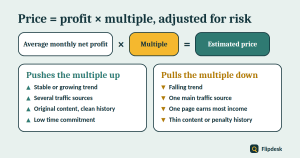
Price = average monthly net profit x multiple
Some marketplaces now quote the same thing as a multiple of annual profit. The result is identical. As an illustration only, a site earning USD 1,000 a month in net profit and valued at 30 times monthly profit would be priced at USD 30,000.
The hard parts are working out the true profit and choosing a multiple that reflects the real risk.
What multiples look like in 2026
Marketplace data varies by source and changes over time, so use these numbers only as a rough guide. Reports in 2026 put typical content and affiliate sites at roughly 24 to 40 times monthly net profit, which is about 2 to 3.5 times annual profit, with exceptional sites selling higher. Flippa’s own H1 2026 report put the average content site sale at 2.32 times annual profit, and the top quarter of sales at 4.68 times.
The range is wide because buyers pay for durability. Sites with growing, varied traffic and several income sources sell for more, and sites that depend on one source of traffic sell for less. Many buyers have also become more careful about sites that rely heavily on search traffic alone.
Other ways to think about value
- Revenue multiple: sometimes used when a site makes money but its costs are unclear. It is less reliable than profit.
- Asset value: for a new site with little or no profit, the value is mostly what it would cost to rebuild: the domain, design, content and any email list.
- Traffic value: pricing by visitors alone is unreliable, because not all traffic earns money.
For an established site, profit is the number that matters most.
Step 1: Get the real numbers
Ask for 12 to 24 months of records
Ask for a month-by-month profit and loss statement covering at least 12 months, and preferably 24. A shorter history makes it hard to see seasonality or a trend.
Verify income at the source
Screenshots and spreadsheets can be edited. Ask the seller to share their screen live while they open the ad network, affiliate dashboards and payment accounts, or to give you read-only access. Then match the figures against bank or PayPal records. If the numbers do not match, stop.
Calculate net profit properly
Net profit is revenue minus all the costs of running the site.
Costs people forget
- Writers, editors and designers
- Hosting, themes, plugins and software subscriptions
- Outsourced link building or SEO work
- Regular content updates
- A fair cost for any task the owner currently does for free but that you would have to pay someone to do
Add-backs to question
Sellers often add costs back to their profit, such as ‘one-off’ expenses or their own salary. Accept an add-back only if it is truly a one-off that will not recur. Ongoing content production and maintenance are not one-offs, even if they are described that way.
Use an average, not the best month
Use the 12-month average, and look at the trend. A seller who prices the site on the last two strong months, ignoring the rest of the year, is showing you the best case, not the real one.
Step 2: Check the traffic
Get access to the analytics
Ask for read-only access to Google Analytics and Google Search Console, or a live screen share. Third-party traffic estimates are only estimates, so first-party data is far more reliable.
Study the trend
Look at 12 to 24 months of clicks and impressions in Search Console. Sudden cliffs, especially ones that line up with a Google update, need an explanation. Our guide on how to recover from a Google core update shows how to read them.
Check where the traffic comes from
Split the traffic by source: organic search, direct, social, email and referrals. A site that gets nearly everything from Google has more risk than one with several sources, including an email list it owns.
Check concentration
Look at the top ten pages by traffic and by revenue. If a single article brings most of the income, the whole value of the site rests on that one page staying where it is in search results.
Look at the keywords
Check which searches bring visitors. Traffic from searches with buying intent usually earns more than broad informational traffic. Also check how much of the traffic comes from the brand name, because that tends to be more stable.
Step 3: Review the content and the site itself
Quality of the content
Read a sample of the articles. Is the content original and useful, or thin, repetitive or copied? A site full of weak pages may need a costly clean-up, as our guide on how to remove thin content without losing traffic explains. Also ask who wrote the content, and make sure the seller has the right to transfer it, including images and any contracts with writers.
Backlinks
Use a backlink tool to check the link profile. Look for natural links from relevant sites, and be wary of sudden spikes, spammy anchor text or links that look like part of a network.
Technical health
Check whether the pages are indexed, whether the site loads quickly, which theme and plugins it uses, and whether the hosting is reliable. Look for any history of hacking or malware.
Domain history and penalties
Check the domain’s history in the Wayback Machine, and run through the checks in our guide on how to check whether a domain has a Google penalty. You cannot see manual actions on a site you do not own, so ask for Search Console access, and verify the domain yourself the moment you take ownership.
Monetization risk
Who pays the site, and how stable is that income? Reliance on one affiliate programme or one ad network is a risk, because the terms can change. Also find out whether the accounts can be transferred. Some ad accounts are tied to the seller and cannot simply be handed over, so check each network’s rules and assume your own earnings may differ.
How much work does the site need?
Ask how many hours a week the owner spends on the site, and what skills it needs. A site that needs 40 hours of skilled work a week is worth less to a buyer who wants passive income.
Step 4: Decide your multiple
What moves the multiple up or down
There is no formula for this part. It is a judgement about risk. In general:
- Pushes the multiple up: a stable or growing trend, several traffic sources, original content, a clean history, an email list, income from more than one source and a low time commitment.
- Pulls the multiple down: a falling trend, one main source of traffic, one page earning most of the income, thin or copied content, a history of penalties and a high time commitment.
A worked example
Here are two sites that earn the same profit, valued differently. The multiples are chosen only to show the principle. They are not predictions.
| Site A | Site B | |
|---|---|---|
| Average monthly net profit | USD 1,000 | USD 1,000 |
| Trend | Stable for 18 months | Falling for six months |
| Traffic | Varied sources | Mostly one article from Google |
| Content | Original and well maintained | Thin and repetitive |
| Time needed | Five hours a week | 20 hours a week |
| Illustrative multiple | 36x | 20x |
| Illustrative price | USD 36,000 | USD 20,000 |
Same profit, very different risk, very different price.
Cross-check against the market
Compare the site with similar listings and, where possible, completed sales on marketplaces such as Flippa and Empire Flippers. Ask any broker what comparable sites sold for.
Do a payback check
Divide the price by the annual profit to see how many years it would take to earn your money back. Then ask yourself what happens if traffic falls by half. If you could not live with that outcome, the price is too high.
Step 5: Run final due diligence and protect yourself
Use escrow
Never pay a seller directly. Use an escrow service, such as Escrow.com or the marketplace’s own escrow, so that money is released only when the assets have been transferred.
Write down what is being transferred
A proper agreement should list every asset: the domain, hosting, website files, content, images, email list, social accounts, affiliate accounts, analytics and Search Console access, and any writer contracts. It should also cover a handover period and a non-compete clause. Have a lawyer review it.
Check trademark and legal issues
Make sure the domain and brand do not copy a well-known name, that images are properly licensed and that the affiliate terms allow the transfer.
After you buy
- Verify the site in Search Console and open the Manual actions and Security issues reports at once
- Change every password and remove the previous owner’s access
- Set up backups
- Start a change log, so you can see what affects traffic
Red flags that should make you walk away
- The seller will not share analytics, Search Console access or a live screen share
- Income cannot be verified at the source
- The price is based on the last two or three months, or on ‘potential’
- Traffic fell sharply and nobody can explain why
- The content is copied, scraped or full of spam
- One page or one keyword accounts for most of the income
- The domain has a history of penalties or spam
- The seller pressures you to skip escrow or to decide quickly
- The numbers do not match between documents
Website valuation checklist
Numbers
- 12 to 24 months of profit and loss records
- Income verified at the source
- Net profit calculated with all real costs
Traffic
- Analytics and Search Console reviewed
- Trend checked against update dates
- Traffic sources and top pages checked
Site
- Content quality and ownership checked
- Backlinks reviewed
- Domain history and penalty risk checked
- Monetisation risks understood
Price
- Multiple chosen with reasons
- Compared with similar sales
- Payback period calculated
Deal
- Escrow used
- Asset list and transfer plan agreed
- Search Console verified and Manual actions checked after purchase
Frequently asked questions
What is a good multiple for a content website?
It depends on the quality and the risk. Reports in 2026 show typical content sites at roughly 24 to 40 times monthly net profit, with stronger sites above that and weaker ones below it. Check current data before you decide.
How much is a website that makes USD 500 a month worth?
As a rough illustration, 24 to 40 times USD 500 is USD 12,000 to USD 20,000. The real figure depends on the trend, the traffic, the content and the risks, so it could be lower or higher.
Do websites with no profit have any value?
Yes, but it is usually the value of the assets: the domain, the content and the design. Such sites are normally priced by what it would cost to rebuild them.
Can I trust traffic estimates from tools?
Only as a rough guide. Always ask for first-party data from Google Analytics and Search Console.
Should I buy a site that depends on Google traffic?
Many sites do, so it is not an automatic no. But you should price the risk in, plan to diversify and make sure you can cope if traffic falls.
How much history should I ask for?
At least 12 months, and preferably 24, so that you can see seasonality and the direction of the trend.
Do I need a broker?
No, but marketplaces and brokers that vet listings can reduce the risk and provide escrow. They charge fees, and you should still verify the numbers yourself.
What should I do first after buying a website?
Verify it in Search Console, check the Manual actions and Security issues reports, change all passwords and set up backups.
Conclusion
Valuing a website well comes down to three habits: prove the profit, understand the risk and never rely on the seller’s word. Get the real numbers, study the traffic, review the content and the history, choose your multiple with reasons, and use escrow.
If you want to practise, take a listing you are curious about and work through the checklist above without any intention of buying. You will quickly learn to see the difference between a healthy site and one that only looks good on paper.

