
Selling a blog can be a good way to turn years of work into a lump sum, or to free up your time for the next project. But a sale goes much better when you treat it as a business transaction: you need clean numbers, a clear story and a safe process.
This guide walks you through the nine steps of selling a blog, from working out what it is worth to handing over the keys. It is educational and is not financial, legal or tax advice, so speak to a qualified professional about the details of your own sale.
Should you sell your blog?
Selling can make sense when:
- you have lost interest or are short of time
- the blog is profitable and stable, but you want to invest in something else
- it has reached a plateau and a buyer could grow it further
- you want to reduce your risk by turning the blog into cash
It is often smarter to wait and fix things first if traffic is falling, if the content is thin, or if you are recovering from a Google update. A blog with an unresolved problem sells for less, and buyers will find the problem anyway. Our guides on how to recover from a Google core update and how to remove thin content without losing traffic can help you get the blog into better shape first.
Step 1: Know what your blog is worth
Calculate your real net profit
Start with the average monthly net profit over the last 12 to 24 months: revenue minus all the costs of running the blog, including writers, editors, tools and hosting. Be honest about the work you do yourself. A buyer will count the cost of doing that work, so you should too. Our guide on how to value a website before buying it explains the method in detail.
Expect a range, not a single number
Blogs are usually priced as a multiple of monthly net profit. Marketplace reports in 2026 put typical content sites at roughly 24 to 40 times monthly profit, with strong sites above that and weak ones below. These numbers move over time, so check current reports and recent sales of similar sites before you set a price.
Step 2: Understand what buyers look for
A buyer is not buying your effort. They are buying a stream of income that they hope will continue. Everything they check is about how likely that income is to survive the handover.
What makes buyers pay more
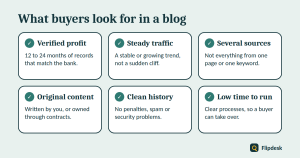
- Verified profit: 12 to 24 months of records that match the bank or payment accounts
- A steady or growing trend: no sudden cliffs
- Several traffic sources: search, direct, email and social, instead of one page or one keyword
- Several income sources: more than one ad network, affiliate programme or product
- Original content that you own: written by you, or owned through proper contracts
- A clean history: no penalties, spam or security problems
- A low time commitment: clear processes that a new owner can follow
- Room to grow: realistic opportunities the buyer can act on
What scares buyers off
- Income or traffic that cannot be verified
- A big share of revenue from a single article
- A recent spike in numbers just before the listing
- Thin, copied or low-quality content
- A domain with a risky history, as our guide on how to check an expired domain’s history explains
- A seller who is vague, defensive or slow to answer questions
Step 3: Prepare your blog for sale
Preparation is where you can raise your price the most. Give yourself a few weeks, or longer for a larger blog.
Clean up your financial records
Create a month-by-month profit and loss statement. Make sure it matches your bank and payment records, and separate personal spending from business costs. Missing or messy records make buyers nervous.
Fix the obvious risks
- Remove or improve thin pages
- Fix broken links and outdated content
- Check Search Console for indexing errors and open the Manual actions and Security issues reports, as explained in our guide to setting up Google Search Console
- Update plugins and themes, and remove anything unused
- Make sure images and any other content you use are properly licensed
Do not try to hide problems. Fix what you can, and plan to disclose what you cannot.
Reduce your own role
Buyers pay more for a blog that does not depend on you. Write simple instructions for the regular tasks: publishing, updating articles, handling writers and managing affiliate links. If writers work for you, make sure their contracts say the content belongs to you, so you can legally transfer it.
Work on your traffic and income mix
If you do not already have one, start an email list. Make sure your income does not rely on a single page. These changes take time, so only do what is genuine. Short-term tricks that inflate your numbers will not survive a buyer’s checks.
List every asset you will transfer
Write down everything that comes with the sale:
- the domain and hosting
- the website files and database
- the theme and plugin licences
- all the content and images
- the email list and email tools
- social media accounts
- affiliate and ad accounts, where they can be transferred
- Analytics and Search Console access
- contracts and contact details for writers and designers
Step 4: Choose where to sell
Marketplaces, brokers and direct sales
There are four main routes:
- Open marketplace: you list the blog yourself and buyers bid or make offers.
- Curated broker: the broker checks your blog and your buyers, helps with pricing and manages the process, for a higher fee.
- Direct sale to a company that buys sites: quicker and simpler, but you may get a lower price.
- Private sale: you find a buyer yourself. It can save fees, but you carry all the risk and the work.
Popular options compared
Fees and minimum sizes change often, and sources disagree, so read each platform’s current terms before you decide.
| Option | Best for | Reported fees | Things to know |
|---|---|---|---|
| Flippa | Small to mid-sized sites, the widest audience | A listing fee plus a success fee, reported at roughly 5 to 10 percent | Mostly self-serve, so vet your buyers carefully |
| Motion Invest | Smaller content sites | Reported commissions of roughly 5 to 20 percent, depending on price | Focused on content sites, and can also buy directly |
| Empire Flippers | Established, profitable sites | Reported at around 15 percent for most deals | Vets sites and buyers, and often has higher size requirements |
| FE International | Larger, higher-value deals | Reported at roughly 10 to 15 percent | A full-service broker, usually for bigger businesses |
| Private sale | Sellers with a buyer already in mind | No platform fee | You manage the risk, the escrow and the paperwork |
Choose by the size of the deal
As a rough guide, smaller blogs tend to suit open marketplaces and direct buyers. Mid-sized sites often do better with a curated broker that brings qualified buyers. Larger businesses often use a full-service broker. If your blog is small, a broker may not accept it at all, and a high commission could eat much of your sale price.
Can you list in more than one place?
Some platforms and brokers require exclusivity. Read the terms before you list the same blog elsewhere.
Step 5: Create a listing that sells
Write an honest, clear description
Cover the essentials in plain language: the niche, the age of the blog, how it earns, the traffic sources, how many hours a week it needs, what has worked and what has not, the opportunities for growth, and why you are selling. A transparent listing attracts serious buyers and avoids awkward surprises.
Show proof
Include charts from Analytics and Search Console, an income breakdown by source and, where the platform allows it, a way for buyers to verify the numbers. Offer read-only access or a live screen share when a buyer is serious.
Set a realistic asking price
Do not anchor on your best month. Base the price on the 12-month average and recent sales of similar blogs, and leave a little room to negotiate. A price that is far too high will simply keep buyers away.
Step 6: Handle buyer questions and due diligence
Expect to be checked
Serious buyers will verify your income, your traffic and your content. Be ready to answer questions quickly and clearly. Slow or vague answers are often what makes a buyer walk away.
Protect your accounts
Never share passwords. Give buyers read-only access to analytics and Search Console, and show payment dashboards on a live screen share instead of handing over a login. Ask serious buyers to sign a confidentiality agreement before you share sensitive details.
Be honest about problems
If the blog has had a traffic drop, a penalty or a weak income source, say so. Hiding it can cause a failed deal or a dispute after the sale, and it may expose you to legal claims for misrepresentation.
Negotiate sensibly
Talk about the price, the payment terms and the handover period. Compare offers on the whole package, not only the headline number. Never agree to be paid outside escrow or the platform.
Step 7: Close the deal safely
Use escrow
Use the platform’s escrow, or an independent service such as Escrow. The buyer pays into escrow first, and the money is released to you only once the assets have been transferred. Never hand over the domain or the site before the funds are secured.
Put it in writing
A proper agreement lists every asset, the price, the payment terms, the handover period, any warranties you are giving, and a non-compete clause that stops you building a competing blog. Ask a lawyer to review it.
Plan the payout and the tax
The payout methods that escrow services and platforms support differ from country to country, and so do the fees. Check which options work for you before you accept an offer. Tax on the sale proceeds also depends on where you live, so speak to an accountant in your country.
Step 8: Transfer the assets and hand over
The transfer checklist
- Domain: unlock it, send the authorisation code or, for .co.uk domains, have your registrar change the IPS tag to the buyer’s registrar
- Hosting and files: move the site, or transfer the account
- WordPress: give the buyer their own admin account, and remove yours at the end
- Search Console and Analytics: add the buyer as an owner or administrator, then remove yourself once the handover is complete
- Email list and tools: export the list and transfer the account
- Social and affiliate accounts: transfer them where the rules allow it
- Writers and contractors: introduce the buyer and share the contracts
Support the handover
A short handover period, often a few weeks, is common. Explain how the blog works, answer questions and make the process smooth. A good handover protects the buyer, and it protects your reputation.
Step 9: After the sale
- Remove your access to every account once the handover period ends
- Keep copies of the agreement, the financial records and the escrow receipts
- Respect the non-compete clause
- Update your own links, and remove any mention of the old blog from your other sites
- Plan your next project, using what you have learnt
Common mistakes when selling a blog
- Listing without clean, verifiable records
- Pricing on the best month or on potential
- Hiding a traffic drop, penalty or weak income source
- Choosing a platform that does not suit the size of the blog
- Sharing passwords instead of read-only access
- Accepting payment outside escrow
- Transferring assets before the funds are secured
- Forgetting to transfer Search Console, Analytics or the email list
Selling a blog checklist
Prepare
- 12 to 24 months of clean profit and loss records
- Net profit calculated honestly
- Thin pages, broken links and security issues fixed
- Processes written down and writer contracts in order
- Full list of assets to be transferred
List
- Platform chosen to suit the size of the deal
- Honest, clear description with proof
- Realistic asking price
Close
- Read-only access only, never passwords
- Escrow used
- Written agreement reviewed by a lawyer
- Payout method and tax checked
Hand over
- Domain, hosting, accounts and email list transferred
- Search Console and Analytics ownership handed over
- Handover support given
- Your own access removed and records kept
Frequently asked questions
How much can I sell my blog for?
It depends on your net profit, the trend, the traffic mix, the quality of the content and the risks. Content sites are often priced at roughly 24 to 40 times monthly profit, but check current data and recent sales of similar sites.
Can I sell a blog that does not make money?
Yes, but the value is usually the value of the assets: the domain, the content and any audience. Expect a much lower price than a profitable blog.
How long does it take to sell a blog?
It can take anything from a few weeks for a direct sale to several months through a broker. Preparation, due diligence and the transfer all take time.
Do I need a broker to sell my blog?
Not necessarily. Small blogs often sell on open marketplaces. Brokers can help with larger or more complex sales, but they charge a commission, and some do not accept small sites.
Which marketplace is best for selling a blog?
There is no single best one. It depends on the size of the deal, the type of site and how much help you want. Compare the current fees, the minimum sizes and the way each one vets buyers.
Should I tell buyers about a Google penalty or a traffic drop?
Yes. Hiding problems can lead to a failed sale, a dispute or legal claims. Buyers will usually find the problem anyway.
Can I keep a copy of the content after I sell?
The content is part of what you are selling, and most agreements include a non-compete clause. Read your agreement carefully, and do not reuse the content.
How do I receive the money if my country has limited payment options?
Check which payout methods the escrow service or marketplace supports in your country before you accept an offer. Options such as bank transfers vary, so confirm the details and the fees early.
Conclusion
A good blog sale is the result of good preparation. Know what your blog is worth, understand what buyers look for, tidy your records and your risks, choose the right place to sell, be honest, use escrow and hand over carefully.
If you are not ready to sell yet, use this guide as a to-do list to make your blog stronger. Everything buyers value, such as clean numbers, steady traffic and original content, also makes the blog better for your own readers.

