

Choosing a niche is the first big decision of a blog, and it shapes everything after it: which keywords you can rank for, which readers you attract and how you can earn. Pick well and every article builds on the last. Pick badly and you can spend a year writing for an audience that is too small, too competitive or simply not interested in paying for anything.
This guide gives you a seven-step process to choose a blog niche that can make money, with ways to test your choice before you commit. It is educational and is not financial advice, and nobody can promise that a blog will earn.
What makes a blog niche profitable?
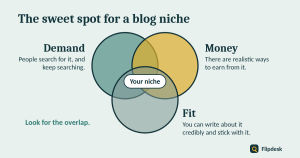
Three things have to overlap
A niche that can make money usually has all three of these:
- Demand: enough people search for the topic, and keep searching for it.
- Monetisation: there is a realistic way to earn from the audience, such as ads, affiliate products, your own products or services.
- Fit: you can write about it credibly, and you will still be interested after your hundredth article.
Miss any one of them and the niche struggles. High demand with no way to earn is a hobby. A great earning potential with no interest from you leads to burnout. A subject you love with no audience will not grow.
Topic vs niche vs audience
A topic is a broad subject, such as fitness or personal finance. A niche is a specific topic aimed at a specific audience with a specific problem. ‘SEO’ is a topic. ‘Recovering small blogs after a Google update’ is a niche. The more specific the niche, the easier it is to stand out and to be the most helpful result for a search.
Step 1: List topics you can stay with
Brainstorm widely
Write down 20 or more topics you know about or want to learn. Include your work experience, your hobbies, problems you have solved and subjects friends ask you about. Do not judge them yet.
Check your credibility
Google’s quality guidelines talk about experience, expertise, authoritativeness and trust, often shortened to E-E-A-T. You do not need a degree for every topic, but you do need real experience or a genuine, honest learning journey to share. Ask yourself what you can add that readers cannot already get from a hundred other sites.
Run the stamina test
Can you imagine 100 article ideas in this topic? Could you write about it every week for a year without dreading it? If the answer is no, the topic is probably too thin or too boring for you.
Step 2: Narrow each topic into a niche
Use the niche formula
A simple formula is: topic + audience + problem. Start broad and keep narrowing until the blog has a clear reader and a clear purpose.
- Broad: personal finance
- Narrower: budgeting
- Niche: budgeting for freelancers with an irregular income
- Broad: SEO
- Narrower: recovering from Google updates
- Niche: recovery plans for small blogs that lost traffic
Why narrow works better for a new blog
A new blog cannot compete with large sites on broad topics. A narrow niche has fewer competing pages and a more loyal audience, and it lets you build the kind of depth that helps Google see your site as a useful source. You can always widen the blog later, once it has traction.
Step 3: Check search demand
Look for enough topics
A healthy niche has plenty of questions people ask. Use Google’s autocomplete, the People Also Ask boxes and the related searches to see how many different topics you could cover. Our guide to keyword research for a new blog explains the process step by step. If you struggle to find 50 distinct article ideas, the niche may be too small.
Check the trend
Open Google Trends and look at the interest in your main topics over the last five years. Is it steady, growing, seasonal or fading? A short-lived fad may bring a quick rush of traffic but will not support a blog for years.
Check the search intent
Look at the kinds of searches people make. Searches with buying intent, such as comparisons, reviews and ‘best’ lists, tend to lead to income. Purely informational searches can still build an audience, but they need a plan to earn from it, such as an email list or a product.
Step 4: Check the competition
Read the search results
Search your main keywords and study the first page. Ask these questions:
- Are the top results all large brands and well-known publishers?
- Do smaller blogs, forums and newer sites also rank? That is a good sign.
- Are the top articles out of date, thin or generic?
- Do the results answer the question well, or is there room for something better?
Look for gaps
A gap can be freshness, depth, a missing audience, a clearer format or a personal angle backed by first-hand experience. A niche where established sites are all alike leaves room for a blog that is genuinely different.
Step 5: Find ways to make money
Before you commit, check that the niche has at least two realistic ways to earn. Relying on a single method is risky.
| Method | Best for | Things to know |
|---|---|---|
| Display ads | Blogs with steady traffic | AdSense has no minimum traffic requirement, but your site still has to meet its policies. Premium ad networks need more traffic, and their thresholds change often, so check each network’s current requirements. |
| Affiliate marketing | Niches with products or services to recommend | You earn a commission on sales. Disclose affiliate links clearly and mark them correctly, and follow the rules in your country. |
| Digital products | Niches where people want templates, guides or courses | Higher margins, but you must build and support the product. |
| Services and consulting | Niches with a clear professional skill | Often the fastest route to income, but it takes your time. |
| Sponsored content | Blogs with a defined, engaged audience | Needs an audience that sponsors want to reach, and clear disclosure. |
| Email list | Any niche | Not income on its own, but it lets you reach readers directly and sell to them over time. |
Check for buyer intent
Look for signs that money already flows through the niche. Are there affiliate programmes? Do advertisers bid on the keywords? Are there products, tools, courses or services that people pay for? If nobody is selling anything, there may be little to earn.
Step 6: Check the risks
Higher-standard topics
Google holds topics that can affect people’s health, finances or safety to higher standards. These are often called ‘Your Money or Your Life’ topics. They include medical advice, financial advice and legal information. You can write about them, but you need real expertise, careful sourcing and clear author details, and you should expect closer scrutiny.
Traffic risk
Simple questions with short answers, such as quick facts and definitions, are increasingly answered directly in search results and by AI tools, which can reduce clicks. Niches where you add depth, experience, tools, original data or a strong opinion are safer, because they give readers a reason to visit.
Dependence on one source
If one programme, one network or one type of traffic supplies almost all of your income, you are exposed. Plan from the start to spread the risk. Our guide on how to value a website before buying it shows how buyers see this risk, and it applies just as much to builders.
Legal and ethical risks
Avoid niches where you would have to make claims you cannot support. Do not promise income or health results. Check that your brand name does not copy a well-known trademark, and make sure that any images and content you use are properly licensed.
Step 7: Test before you commit
Run a small test
Publish 10 to 15 articles over two or three months, aimed at specific, lower-competition searches. Make sure each one follows the basics in our on-page SEO checklist for beginners, and set up Search Console as described in our guide to setting up Google Search Console, so you can see which topics get impressions and clicks.
Track the right signals
- Impressions and clicks per topic
- Which articles begin to rank, even at low positions
- Email sign-ups
- Early income or affiliate clicks, however small
Decide with data
After the test, you have three choices: double down on the topics that are working, adjust the angle, or move on to a different niche. A niche that shows early signs of demand and ways to earn is worth more of your time. A niche where nothing moves after steady effort is a signal to rethink.
A simple niche scorecard
Score each of your niche ideas from 1 to 5 on each question, then compare totals. There is no magic number. The point is to compare your ideas fairly.
| Question | Score (1 to 5) |
|---|---|
| Is there steady search demand with plenty of topics? | |
| Is the competition beatable for a new blog? | |
| Are there at least two realistic ways to earn? | |
| Do I have real experience or genuine interest? | |
| Will the topic still matter in five years? | |
| Is the risk (legal, YMYL, platform) manageable? |
Common mistakes when choosing a niche
- Choosing only because you love it, or only because it pays well
- Picking a niche that is too broad
- Ignoring the competition
- Chasing a fad
- Copying someone else’s success without checking whether it fits you
- Relying on a single way to earn
- Never testing the idea before investing months
- Expecting quick income
Blog niche checklist
Idea
- 20 or more topic ideas listed
- Credibility and stamina checked
Narrowing
- Topic, audience and problem defined
- Niche narrow enough to stand out
Demand and competition
- At least 50 article ideas found
- Trend checked in Google Trends
- First-page results studied for gaps
Money
- At least two realistic ways to earn
- Buyer intent confirmed
Risk and test
- Risks checked
- 10 to 15 test articles published
- Results reviewed with data
Frequently asked questions
How do I find a profitable blog niche?
List topics you can stay with, narrow them into specific niches, then check demand, competition and ways to earn. Finally, test the idea with a small batch of articles.
Can I blog about more than one niche?
You can, but a new blog usually does better with one clear focus. Build depth in one niche first, and widen the blog later if you want to.
How many articles do I need to know if a niche works?
There is no exact number, but 10 to 15 well-targeted articles over a few months usually give you early signals. Judge the trend, not a single article.
Do I need to be an expert?
Not always, but you do need real experience or an honest, documented learning journey. For topics that affect health, money or safety, expertise matters much more.
Is it too late to start a blog in a competitive niche?
Not if you narrow down. A specific audience and a fresh angle can still win, even where broad topics are dominated by large sites.
Can I change my niche later?
Yes, but it costs time. Some content may no longer fit, and you may need to start building authority again. Testing first reduces the chance of a switch.
How long does it take for a blog to make money?
There is no fixed answer. Many blogs take months or years to earn meaningful income, and some never do. Be wary of anyone who promises a timeline.
Should I pick a trending niche?
Be careful. Trends can fade quickly. Choose a niche with steady, long-term demand, and treat a trend as a bonus rather than the foundation.
Conclusion
The best blog niche is the one where demand, money and fit overlap. Brainstorm, narrow, check demand and competition, confirm that there are real ways to earn, weigh the risks and test with a small batch of articles before you commit.
Then build on it step by step. Our guides to keyword research, on-page SEO and Search Console will help you turn the niche into a blog that can grow, and our guides on valuing and selling a blog show where a well-built site can go later.